A great tutorial level teaches by turning the first lesson into play. Instead of pausing the game for a long explanation, it gives players a safe problem, a visible goal, and a satisfying reason to try the mechanic themselves.
Player Learning Snapshot
- Tutorial levels work best when they teach one idea at a time, then ask the player to use that idea in a slightly different context.
- The level should make the right action discoverable through layout, camera, sound, enemy placement, and reward timing.
- Good tutorials respect failure. They let players experiment without punishment that feels bigger than the lesson.
- A tutorial is not only for buttons. It introduces tone, pacing, rules, risk, and the kind of thinking the game expects.
Teaching works better when the player feels agency
The difference between a tutorial and a lecture is control. A lecture tells the player what the designer already knows. A good tutorial level lets the player discover enough of that knowledge to feel ownership over it.
This is why level design fundamentals often focus on readability. The Epic Developer Community’s level design overview describes levels as spaces that need to be read quickly while still supporting entertainment. That idea is especially important in tutorials, where the player is reading interface, environment, movement, threat, and reward at the same time.
A tutorial that interrupts constantly may be clear, but it can also teach the player that the game will solve problems for them. A better opening space makes the first answer tempting. A low ledge invites a jump. A locked door makes the key meaningful. A harmless enemy teaches timing before a dangerous enemy tests it.
The first lesson should be narrow but expressive
Many weak tutorials fail because they try to teach the whole game at once. The player meets movement, camera control, inventory, crafting, stealth, combat, dialogue choices, upgrades, and map markers before any single system feels natural. The result is not depth. It is noise.
A strong tutorial narrows the first lesson but shows expressive potential. If the mechanic is climbing, the first climb may be short, but the view from the top hints at exploration. If the mechanic is parrying, the first enemy may be slow, but the sound and animation make timing feel powerful. If the mechanic is conversation choice, the first choice may be low risk, but the reaction should prove that words change relationships.
Academic work on tutorial level design, including an ACM study on tutorial level design guidelines for fighting games, reinforces the idea that tutorials are learning environments, not just information screens. The player needs practice, feedback, and gradually adjusted challenge.
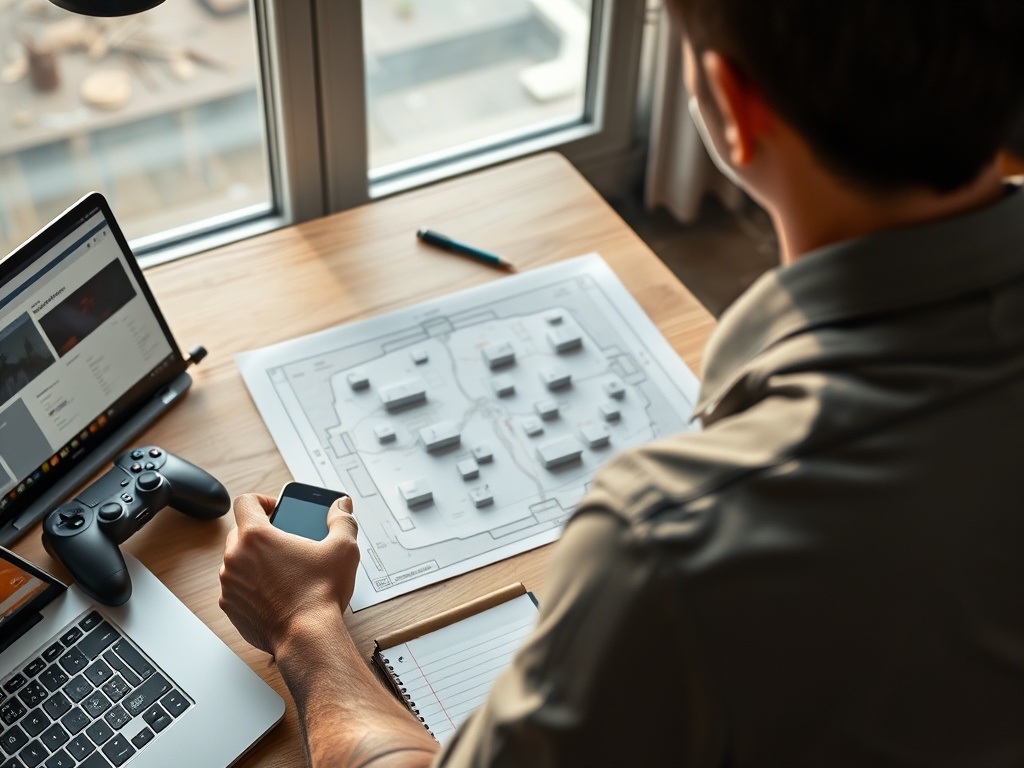
[Image Placeholder 1: A game design workspace with a level map sketch, controller, laptop with blurred interface blocks, and sticky notes showing unreadable symbols, photographed in natural side light.]
The best tutorials use the level itself as the teacher
| Teaching method | How it feels to the player | Risk if overused | Best use |
|---|---|---|---|
| Text prompt | Direct and fast | Can break immersion | Controls that cannot be inferred visually |
| Environmental cue | Natural and exploratory | Can be missed | Direction, hazard, scale, and safe paths |
| Demonstration | Helpful without pressure | Can feel passive | Showing a mechanic before asking for precision |
| Safe failure | Encourages experimentation | Can feel consequence-free | Early movement, timing, and puzzle logic |
| Escalating remix | Builds mastery | Can become too steep | Testing the same mechanic under new conditions |
The strongest tutorial levels combine these methods instead of relying on one. A text prompt might explain the button, but the room layout explains why the button matters. A safe platform teaches the jump, but a slightly wider gap teaches commitment. A non-lethal enemy teaches attack range, then a faster enemy teaches timing.
This structure has a close cousin in serialized storytelling. A first volume of a comic introduces the reading rules while promising future complexity, which is why the craft question behind what makes a great first volume hook in serialized comics feels surprisingly similar to tutorial design.
Friction should come from learning, not confusion
A tutorial can be challenging. It should not be confusing for the wrong reasons. If the player fails because the objective is invisible, the input is inconsistent, or the camera hides the hazard, the level is teaching mistrust. If the player fails because they are learning timing, reading enemy tells, or testing a rule, the failure can still feel fair.
Good tutorial friction usually has three traits. First, the player can identify what went wrong. Second, the restart is quick enough that retrying feels natural. Third, the correction is within the player’s control. A long runback, unclear feedback, or random punishment makes a beginner feel judged rather than invited.
This matters because the tutorial sets emotional expectations. If the first playable minutes feel respectful, players are more likely to interpret later difficulty as intentional. If the first minutes feel bossy or opaque, later complexity may feel like more of the same problem.
Tutorials also teach tone and identity
A tutorial level is not only mechanical. It is the first playable argument for what the game is. A cozy farming game should not teach through panic unless panic is part of the premise. A tactical game should introduce observation and planning early. A horror game may deliberately make the player feel underprepared, but it still has to distinguish designed vulnerability from broken guidance.
This is where visual and audio design matter. Color can mark safety or danger. Music can relax or tighten the player. Animation can show weight, confidence, clumsiness, or fear. The tutorial is often the first place where those signals become interactive.
Designers should also consider accessibility from the beginning rather than treating it as a menu afterthought. Readable prompts, remappable controls, clear contrast, adjustable timing pressure, and captions can make the teaching more inclusive. Accessibility does not weaken a tutorial. It makes the lesson clearer for more players.
How to tell if a tutorial level is doing its job
The best test is not whether the player can repeat the instruction. It is whether they can use the lesson in a new situation. After the first jump, can they recognize the next jump? After the first stealth takedown, can they identify line of sight? After the first rhythm input, can they recover when the tempo changes?
Designers can watch for hesitation points. If many players stop in the same place and look lost, the level may not be readable. If players understand the goal but execute poorly, the lesson may need slower ramping. If players succeed but cannot explain why, the tutorial may be too automatic.
A better first lesson
A great tutorial does not disappear because it says nothing. It disappears because everything it says is embedded in play. The player learns, but they also moves, chooses, risks, recovers, and feels the game respond.
The next step for a designer or curious player is to replay a favorite opening level and note where the game teaches through space rather than text. The moments that feel obvious are often the result of careful craft. When a tutorial feels effortless, someone probably worked very hard to make the first lesson feel like an invitation.