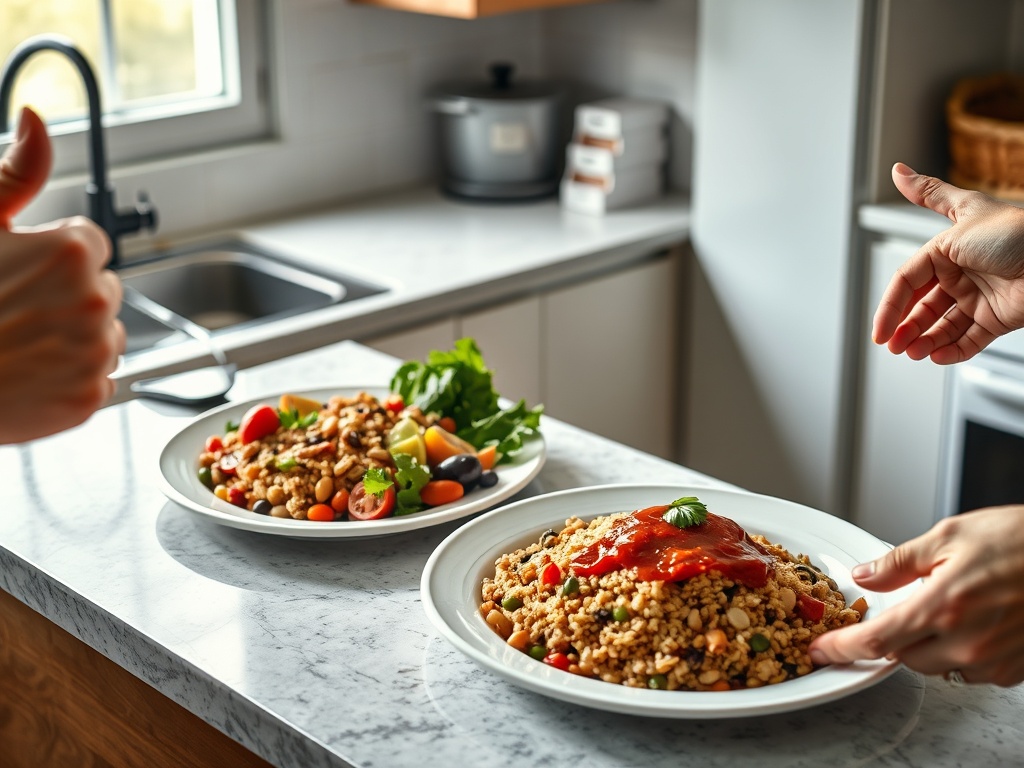
Calorie density is the amount of food energy packed into a given weight of food, usually expressed as calories per gram. Using it well means choosing enough lower-calorie, water- and fiber-rich foods to create satisfying meals while still leaving room for energy-dense foods you enjoy and need.
Food Volume Lens
- Lower calorie density usually comes from more water and fiber and less concentrated fat or sugar.
- Use substitution, not unlimited addition: adding low-calorie foods on top of an unchanged diet can still raise total intake.
- Portion size still matters for energy-dense foods, even when they are nutritious.
- Appetite control is individual; calorie density is a tool, not a diagnosis or a required diet.
Think in food volume, not "good" and "bad" foods
Calorie density helps explain why two meals with similar plate size can contain very different amounts of energy. Foods that contain more water often provide more physical volume for fewer calories, while foods with concentrated fat, added sugar, or little water can deliver more calories in a smaller volume.
The CDC explains that fruits and vegetables can add water, fiber, and volume to meals while replacing higher-calorie ingredients. Its guidance on fruits, vegetables, and weight management also makes an important distinction: substitution is the key. If lower-calorie foods are simply added to everything you already eat, total calories can still rise.
Use the plate as a practical calorie-density tool
You do not need to calculate calories per gram for every ingredient. A simpler method is to build more of the meal from foods that naturally contain water and fiber, then add a sensible portion of protein, starch, and fats according to your needs.
| Meal component | Lower-density direction | What to watch |
|---|---|---|
| Vegetables and fruit | Fresh, frozen, steamed, roasted with modest added fat | Sauces, syrups, frying, heavy dressings |
| Protein | Lean meats, fish, eggs, beans, lentils, lower-sugar dairy | Added oils, breading, large high-fat portions |
| Starches | Potatoes, oats, rice, whole grains with vegetables or broth-based dishes | Butter, cream sauces, fried preparation |
| Fats and toppings | Use for flavor and nutrition in measured amounts | Oils, nut butters, cheese, dressings are easy to pour freely |
| Snacks | Whole fruit, yogurt, vegetables with a portioned dip | Large bags or containers that obscure serving size |
This framework preserves flexibility. A bowl of pasta can become more filling for the same general meal size when vegetables and a protein source take up more of the bowl and the sauce is not dominated by added fat. A sandwich can become more substantial with vegetables and fruit on the side rather than simply adding a second sandwich.
Read labels for concentration, not just a single calorie number
Packaged-food labels make calorie density easier to interpret because they show both calories and serving size. The serving size is a reference amount, not a personalized recommendation, but it helps you compare foods and recognize when a small-looking portion contains a large share of the package's calories.
The CDC's Nutrition Facts Label overview recommends checking how many servings are in a package and paying attention to calories along with nutrients such as saturated fat, sodium, and added sugars. For calorie density, compare foods in amounts you would realistically eat rather than selecting the product with the lowest number on the front of the package.
A light-looking snack can still be energy dense if most of its calories come from concentrated fat or sugar. Conversely, a meal may have more total calories because it is a full meal, yet be less calorie dense because it contains a larger amount of vegetables, fruit, broth, beans, or other high-water foods.
Protein, fiber, and texture still matter
Calorie density is only one part of satiety. Protein, fiber, food texture, eating speed, sleep, stress, and individual preferences can influence how full you feel. That is why a plate made entirely of very low-calorie vegetables may not be satisfying for long if it lacks adequate protein, carbohydrate, or fat for your needs.
Use the tool to build meals, not to compete for the lowest possible calorie number. A practical meal often combines a high-volume base with a protein source, a carbohydrate source, and a modest amount of fat or sauce for flavor. That combination tends to be more sustainable than trying to remove every energy-dense ingredient.
If you are also training for strength, adequate food intake matters for performance and recovery. Our bodyweight strength progression guide is a reminder that training progress depends on what you can repeat and recover from, not simply on making meals smaller.

Apply substitution in the meals you already eat
The easiest way to use calorie density is to modify familiar meals. Keep the core food you like, then change the ratio of components.
For breakfast, add fruit to oats or yogurt and use a portion of nuts rather than pouring from the container. For lunch, add a vegetable-heavy soup, salad, or fruit to a sandwich instead of relying on chips alone for volume. For dinner, increase the vegetable portion in a stir-fry or pasta dish while keeping enough protein and starch to make the meal satisfying.
Soup illustrates the concept well when it is broth-based and filled with vegetables, beans, or lean protein. Water becomes part of the food volume, so the bowl can be physically large without requiring the same energy concentration as a cream- or oil-heavy dish. The exact effect depends on ingredients and portion size, so avoid assuming every soup is low in calories.
Avoid the most common calorie-density mistakes
The first mistake is labeling high-density foods as forbidden. Restriction can make a plan difficult to sustain and can obscure nutritional value. Olive oil, avocado, nuts, and cheese are energy dense, but that does not mean they must disappear. Use portions that fit the meal.
The second mistake is assuming "healthy" means low calorie. Granola, smoothies, trail mix, restaurant salads, and nut-based snacks can be nutritious and still contain substantial energy in a relatively small amount. That may be useful for an athlete with high energy needs and less useful for someone trying to create a modest calorie deficit without feeling hungry.
The third mistake is chasing volume so aggressively that meals become joyless or nutritionally incomplete. Appetite control is not a contest to eat the largest possible plate for the fewest calories. It is about finding an eating pattern that supports health, energy, and a goal you can maintain.
Use a one-week experiment before changing everything
For one week, choose one meal per day and make one calorie-density change. Add a vegetable or fruit, swap a fried preparation for a less oil-heavy method, portion a concentrated topping, or replace part of a refined snack with a higher-volume option. Keep the rest of the meal recognizable.
Notice appetite two to four hours later, energy during the day, training quality, and whether the change feels easy to repeat. Those observations are more useful than forcing a dramatic meal plan that lasts three days.
If weight or body composition is one of your goals, combine food observations with performance and consistency measures. Our fitness-progress dashboard guide shows how to keep scale changes in perspective alongside strength, cardio, recovery, and routine adherence.
Make density work for your appetite, not against it
Calorie density is powerful because it changes the structure of a meal without requiring a list of banned foods. Fill more of the plate with water- and fiber-rich foods, keep satisfying protein and carbohydrates, and portion concentrated fats and treats intentionally.
Start with one meal you already like. Make it slightly higher in volume and slightly less energy concentrated, then see whether you stay satisfied. If the change supports your energy, health, and goals, repeat it. If it leaves you hungry or under-fueled, adjust the balance rather than assuming you failed the method.